
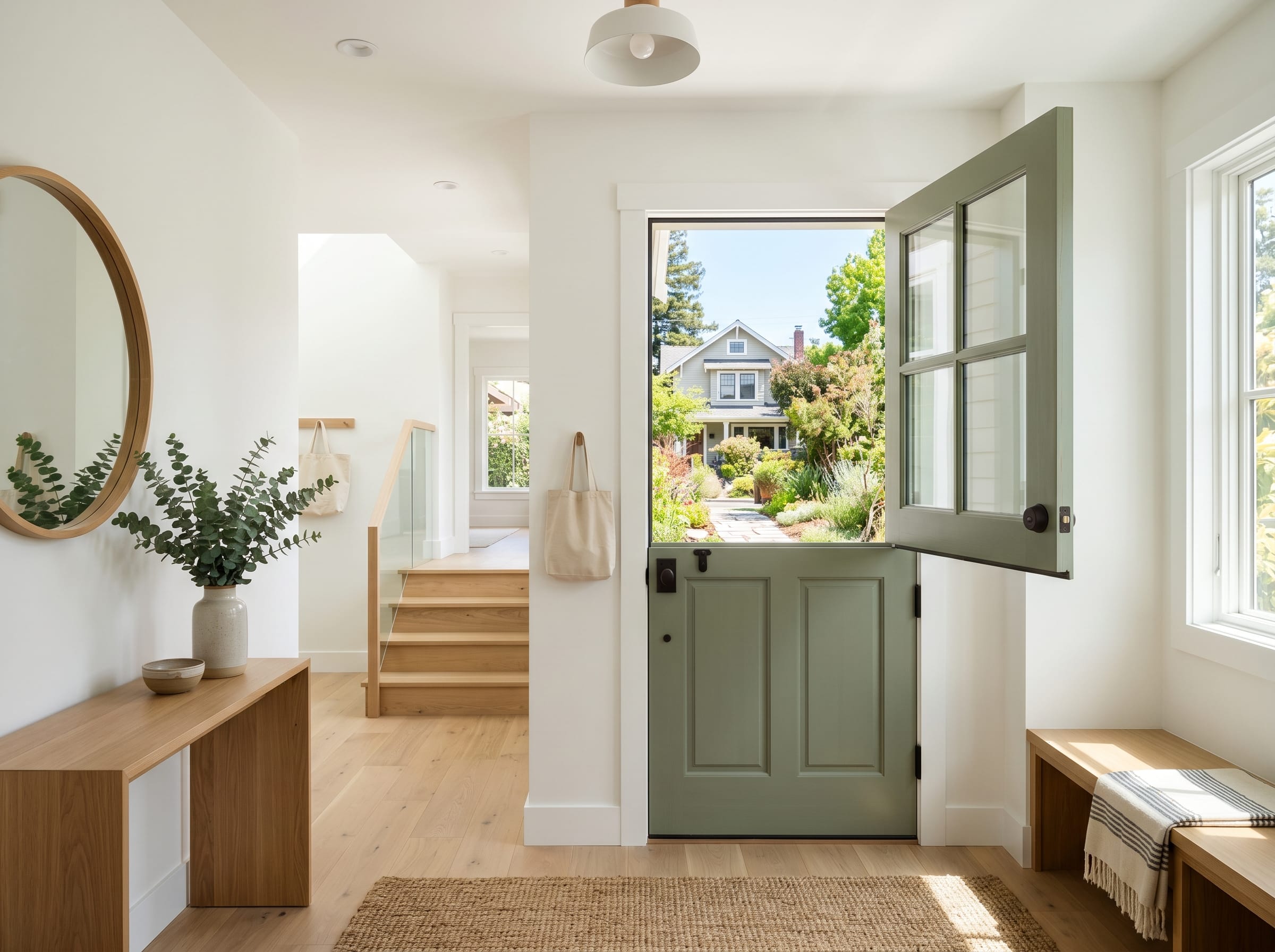
Dutch Doors in Office Interior Design
Open-plan offices became the default in American workplaces over the past two decades. Then the pandemic made it impossible to ignore what anyone who’d worked in one already knew: full acoustic and visual openness is exhausting. Private offices came back. Collaborative zones with defined edges replaced the everything-open floor plan.
A Dutch door into a meeting room or a manager’s office solves a specific problem. You can tell someone is in there. You can decide whether to knock, wave through the glass, or come back in ten minutes. That small visual cue cuts interruptions in a way a fully open door never could, and a fully closed one often won’t.
For office interiors, the glass-upper configuration tends to work best. Lower panel in solid wood or whatever material matches the room’s existing millwork. Frosted glass on the upper half gives enough privacy for a focused conversation without turning the room into a bunker.
What a Local Designer Knows That This Article Doesn’t
A lot of Dutch door questions only have local answers:
- What rough opening sizes are standard in buildings from your construction era?
- Does your climate require a thermal break in the frame?
- Which millwork suppliers near you carry pre-hung Dutch door units, and which ones require full custom fabrication?
No blog post answers those for your specific building. A designer who has installed Dutch doors in your region will already know the local lumber yards, what custom fabrication actually costs there right now, and which contractors do the installation without making a mess of your existing trim.
If you’re planning a larger project, whether that’s a kitchen renovation, an office redesign, or a residential layout rework, it’s worth getting a professional read before you commit to a door style and hardware. The structural side is usually simple. Getting the finished door to sit right against your existing trim, flooring, and wall color takes someone who has done it before.
A Note on Clearance
Dutch doors need more swing clearance than standard doors because both halves operate independently. In tight hallways or rooms where furniture sits close to the frame, this matters. Check it before you order anything.
Standard Dutch doors run 6’8″ tall, split at roughly 40 to 42 inches, which lines up with most countertops. That lower sill height is comfortable to lean on, which is part of why the design works in office settings.
Non-standard openings in older buildings or apartments will usually need custom fabrication. Budget $800 to $2,500 for the door itself depending on material, hardware, and where you are, before installation.
One Last Thing
Dutch doors work because they handle a real problem: how to signal availability without fully opening or fully closing a space. The split-door concept is old enough that it has nothing left to prove. What has changed is that current materials and hardware make it easier to integrate into anything from a modern apartment to a traditional farmhouse to a corporate office floor.
If you’re rethinking traffic flow, privacy, or how a space signals openness, it belongs on the list.
Ready to bring your interior vision to life? Contact MQ Architects today to schedule a design consultation. We work across residential and commercial projects and respond within 24 hours.
0 comments